
What Should You Ask Before Hiring a Logo Designer?
Hiring a professional logo designer is one of the most critical investments you will make when building your company brand identity. Your logo is often the very first visual asset a prospective customer sees. It sets the tone for your website, anchors your marketing campaigns, and appears on your packaging, invoices, and physical signage for years to come.
However, hiring a graphic designer or branding agency can feel overwhelming if you do not know what to look for. The market is filled with everyone from inexperienced hobbyists using automated template tools to seasoned design agencies delivering complete corporate identities.
If you hire a designer without asking the right questions upfront, you risk ending up with unoriginal artwork, missing source files, blurry print materials, or unexpected hidden fees.
Taking the time to interview and vet your design candidates before signing a contract protects your budget and guarantees a smooth creative partnership. This comprehensive guide covers the essential questions you must ask before hiring a logo designer, why each question matters, and what answers to look for.
If you are beginning your search for a dedicated creative team, exploring the logo design services at Innovative Logo will show you how a structured, transparent design partnership functions.
Why Asking the Right Questions Protects Your Business

A logo design project is not just an artistic exercise. It is a strategic business collaboration. The designer you choose must understand your market, follow professional technical standards, and provide legally protectable visual assets.
Small business guidance from the U.S. Small Business Administration (SBA) stresses that establishing a distinctive brand identity is crucial for building customer loyalty and standing out in a crowded marketplace. If your designer creates artwork that cannot be trademarked or files that cannot be enlarged for print signage, your business will face costly delays and rebranding expenses down the road.
Asking targeted questions before paying a deposit ensures that you and your designer share clear expectations regarding scope, deadlines, ownership, and technical deliverables.
When you invest in a custom logo design, having upfront clarity guarantees you receive an asset package ready to support your business expansion.
1. Questions About Experience, Portfolio, and Industry Background
Reviewing a designer portfolio is always the first step, but you need to look beyond surface aesthetics to understand their practical experience.
Can I Review Relevant Work and Case Studies in My Niche?
Every industry has unique visual conventions, customer expectations, and technical requirements. A style that works well for a trendy coffee shop might look completely out of place for a corporate law firm or medical clinic.
Ask the designer:
- Have you worked with businesses in my industry or with a similar target audience?
- Can you walk me through a case study explaining the strategy behind a recent logo project?
- What was the original problem the client had, and how did your design solve it?
Look for designers who discuss their work in terms of business goals, user psychology, and market positioning rather than just artistic preference.
You can inspect examples of diverse, industry specific brand identities by browsing the portfolio at Innovative Logo.
What Is Your Experience in Designing for Both Print and Digital Media?
A logo must perform seamlessly across both digital displays and physical materials. A designer who only understands web design might create complex neon gradients that look striking on a screen but turn muddy and dark when printed on paper or embroidered on uniforms.
Professional standards documented by the American Institute of Graphic Arts (AIGA) highlight that professional brand designers must possess a strong understanding of color systems, typography scale, and physical manufacturing constraints.
Make sure your designer understands both RGB color spaces for digital screens and CMYK or Pantone spot color matching systems for physical printing presses.
2. Questions About the Design Process and Creative Strategy
A professional logo design project should follow a structured, proven methodology rather than relying on random guesswork.
What Specific Steps Are Included in Your Creative Workflow?
Experienced designers follow a systematic creative journey from research to delivery.
Ask your prospective designer to outline their exact workflow:
- Discovery and Creative Brief: Do they provide an intake questionnaire to learn about your company values, ideal clients, and brand tone?
- Market and Competitor Research: Do they evaluate your direct competitors to ensure your new logo looks distinctive?
- Concept Exploration: How many initial creative directions will they present for your review?
- Iterative Revisions: How does the team handle feedback and concept refinement?
- Final File Preparation: How are master files exported, tested, and delivered?
If a designer states that they skip research and immediately jump into drawing graphics, you are dealing with a software operator rather than a strategic brand consultant.
How Do You Research My Target Audience and Competitors?
Your logo is not designed for you. It is designed for your ideal customers. A great designer takes time to understand who your customers are, what visual cues build trust with them, and what your competitors are doing in the market.
Research insights from Forbes Business Council indicate that companies with well-researched, consistent branding build higher customer trust and command stronger market authority than businesses relying on generic graphics.
Ensure the designer asks detailed questions about your customer demographics, price points, and unique value propositions before beginning any sketching.
3. Questions About File Deliverables and Technical Formats
The technical deliverable package is where many business owners get caught off guard. You must ensure you receive complete production files, not just a couple of basic images.
What Exact Master Vector and Raster Files Will I Receive?
Never hire a designer who only provides standard JPEG or PNG files. Raster image formats are composed of fixed pixel grids that become blurry and distorted when scaled up for signage or vehicle graphics.
You must confirm that the designer will deliver scalable vector source files. Vector files use mathematical points and curves that can be resized infinitely without losing quality.
Your final package should include:
- AI (Adobe Illustrator) or EPS: Master vector files required by print shops, sign manufacturers, and future designers.
- SVG (Scalable Vector Graphics): Modern vector format built for responsive website headers and web applications, defined by open standards from the World Wide Web Consortium (W3C).
- Vector PDF: High resolution vector document accessible for review and commercial printing.
- Transparent PNG Files: High resolution 300 DPI raster files with clear backgrounds for everyday digital use, office documents, and presentations.
- High Resolution JPEG Files: Standard images for email signatures and social media posts.
Do You Provide Responsive Layout Variations and Sub-Marks?
A single horizontal logo cannot fit into every marketing space. A complete identity package requires responsive variations derived from your core mark.
Ask if the final deliverables include:
- Primary Horizontal Lockup: For website headers, desktop navigation menus, and rectangular banners.
- Secondary Stacked Lockup: For square packaging, presentation slides, and trade show displays.
- Standalone Sub-Mark / Icon: For social media profile pictures, mobile app icons, and browser favicons.
- Monochrome and White Knockout Versions: For single color printing, dark backgrounds, and dark mode website themes.
To review how comprehensive design packages organize vector master files, responsive variations, and brand collateral, visit our pricing page.
4. Questions About Concepts, Revisions, and Project Timelines
Clear parameters around revisions and project milestones keep your project on schedule and within budget.
How Many Unique Concepts and Revision Cycles Are Included?
Misunderstandings around revisions are a leading cause of client frustration in creative projects.
Clarify these specific numbers:
- How many completely distinct initial logo concepts will you present in the first round?
- Exactly how many rounds of revisions are included in the base project fee?
- What is your definition of a revision round versus a total concept redesign?
- What is the hourly rate or additional fee if we require adjustments beyond the included rounds?
Industry benchmarks established by the Graphic Artists Guild show that two to three structured revision rounds are standard for most brand identity projects.
What Is the Complete Project Timeline From Start to Finish?
You need a clear timeline to coordinate your website launch, business card printing, and marketing campaigns.
Ask the designer:
- When can I expect to receive the initial concepts after submitting the creative brief?
- How many business days do you require to turn around feedback during each revision round?
- What is the estimated project completion date?
- What is expected from my team in terms of feedback turnaround times to keep the project on schedule?
A typical custom logo project takes between one and three weeks, allowing adequate time for research, concept generation, client review, and multi-format exports.
5. Questions About Pricing, Contracts, and Payment Milestones
Financial transparency is essential for a professional working relationship.
What Is the Total Cost and What Is the Payment Structure?
Avoid vague pricing estimates that can expand as the project progresses.
Ask for clear payment terms:
- Is the project priced as a fixed flat fee or an hourly rate?
- What is the deposit requirement? (A standard industry deposit is 50 percent upfront, with the remaining 50 percent due upon final approval before file delivery).
- Are there any additional expenses, such as third party font licensing fees or stock photography costs?
- What payment methods do you accept?
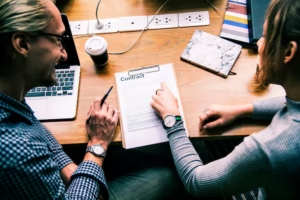
A written contract or formal proposal should clearly state all deliverables, revision limits, and payment milestones before any money changes hands.
What Happens If We Do Not Approve Any Initial Concepts?
While rare when working with experienced agencies, you should understand the policy if the initial directions do not match your vision.
Ask:
- What is your process if none of the first round concepts resonate with our team?
- Do you offer a concept reset round based on updated creative guidance?
- Is there a kill fee or cancellation policy outlined in the contract if we decide to terminate the project early?
Professional agencies have clear contingency clauses in their service agreements to protect both parties if a creative mismatch occurs.
To learn more about our company background and transparent client policies, visit the about us page on the Innovative Logo website.
6. Questions About Intellectual Property, Copyright, and Trademarks
Legal ownership of your branding is non negotiable. You must ensure you own full legal rights to the artwork.
Do I Receive 100 Percent Full Copyright Ownership?
When you pay for a custom logo design, you must receive complete, unrestricted commercial copyright ownership upon final payment.
Ask:
- Will you provide a written, signed intellectual property transfer agreement or copyright release?
- Does your agency retain any ongoing licensing rights or claim future royalty fees for commercial use of the logo?
- Does the agreement grant me the unrestricted right to register the mark as an official trademark?
Never work with a designer who attempts to retain copyright or license your own company logo back to you on an ongoing basis.
Do You Guarantee Original Artwork Without Stock Elements?
One of the biggest risks in budget design is the use of pre made stock clip art or downloaded templates.
Trademark regulations from the United States Patent and Trademark Office (USPTO) explicitly require that visual trademarks must be original works. Stock illustration libraries sell non-exclusive licenses to thousands of people, meaning stock artwork cannot legally be registered as a protected trademark.
Ask the designer:
- Do you guarantee in writing that all shapes, icons, and illustrations are 100 percent original and created from scratch?
- Do you perform preliminary reverse image searches to ensure the design does not unintentionally resemble an existing mark?
- What steps do you take to avoid copyright infringement?
Quick Summary Checklist: What to Ask Before Signing
Use this quick summary list when interviewing prospective logo designers:
- Can you show me relevant case studies and examples from my industry?
- What are the specific stages of your design workflow?
- How do you research my target audience and competitors?
- Which master vector files (AI, EPS, SVG, PDF) and raster formats are included?
- Do you provide responsive variations, sub-marks, and monochrome layouts?
- How many initial concepts and revision rounds are included in the base price?
- What is the complete project timeline and delivery schedule?
- Is the price a fixed flat fee, and what is the payment structure?
- What happens if we need additional revisions or a concept reset?
- Do I receive a signed document transferring 100 percent copyright ownership?
- Do you guarantee that all artwork is 100 percent original without stock templates?
- Do you provide a brand style guide documenting exact color codes and font specifications?
Frequently Asked Questions About Hiring a Logo Designer
How much should I expect to pay for a professional custom logo design?
Professional custom logo design for small to medium businesses typically ranges from several hundred to a few thousand dollars depending on the scope of deliverables, revision rounds, and brand strategy included. Extremely cheap options (under fifty dollars) usually rely on automated templates or stock graphics that cannot be trademarked.
What is the difference between hiring a freelance designer and a design agency?
A freelance designer is an individual specialist who handles the project directly, often offering lower overhead costs. A design agency provides a broader team of strategists, illustrators, and developers, offering comprehensive branding systems, faster turnarounds, and multidisciplinary capabilities for growing businesses.
What should I prepare before contacting a logo designer?
Before contacting a designer, prepare a brief summary of your business, your target audience, your primary competitors, your preferred brand values (such as modern, luxurious, playful, or corporate), and your target launch deadline. Having this information ready helps the designer provide an accurate proposal.
Why is a vector file format mandatory for my business logo?
Vector files (AI, EPS, SVG) use mathematical equations instead of pixels to render graphics. This allows your logo to scale from a tiny 16-pixel website favicon to a twenty-foot commercial billboard without any loss of clarity or pixelation. Raster formats like PNG or JPG blur when enlarged.
What is a brand style guide and why do I need one?
A brand style guide is an instruction document that explains how to use your logo correctly. It outlines your official color codes (HEX, RGB, CMYK, Pantone), font pairings, clear space margins, and minimum display sizes, ensuring your team and third party vendors maintain visual consistency across all marketing materials.
Can I trademark a logo if the designer used stock icons?
No. Stock graphic platforms explicitly forbid users from claiming exclusive ownership or registering stock vector elements as legal trademarks. To protect your brand legally with the USPTO or international trademark bodies, your logo must be 100 percent original custom artwork.
Final Thoughts on Finding the Right Logo Designer
Choosing the right logo designer is a foundational decision that impacts your company visual reputation for years to come. By asking targeted questions about creative strategy, technical deliverables, revision boundaries, and legal ownership, you eliminate guesswork and build a successful creative partnership.
A reputable designer will welcome your questions, provide clear written answers, and demonstrate a thorough understanding of both artistic design and commercial business needs.
If you are looking for an experienced, transparent design team that delivers custom original artwork, complete master vector packages, and full copyright ownership, contact Innovative Logo today. You can also explore our complete branding packages, design capabilities, and client work on the Innovative Logo home page to take the first step toward building a distinctive visual identity that elevates your business.Hiring a professional logo designer is one of the most critical investments you will make when building your company brand identity. Your logo is often the very first visual asset a prospective customer sees. It sets the tone for your website, anchors your marketing campaigns, and appears on your packaging, invoices, and physical signage for years to come.